

Travel is terribly revealing
I have always thought you should travel with someone before you marry them. Not because travel is particularly romantic. Quite the opposite. Miss a flight together. Lose a suitcase. Get hungry somewhere neither of you speaks the language. Try to navigate an unfamiliar city when one of you is tired and the other is absolutely certain the hotel is that way. Travel has a remarkable capacity to reveal the person underneath the well-rehearsed version.
What interests me more these days is what travel reveals when the person you are travelling with is yourself. When did you last go somewhere nobody knew who you were supposed to be? Not simply take a holiday, but spend enough time outside your ordinary life that your usual coordinates became less useful. When did you last wake without somebody needing something from you, walk out of a door without knowing exactly where you were going, eat when you were hungry rather than when everyone else was ready, or spend a day making decisions that affected nobody but you? And if it has been a while, who have you become while staying home?
We talk about travelling to “find ourselves” as though the self were a misplaced object waiting patiently behind a temple in India. There is a reason that the story has such cultural resonance. Eat, Pray, Love did not become a phenomenon simply because millions of women suddenly developed an interest in Italian carbohydrates and Balinese spirituality. Something about the woman who leaves the life she knows in order to encounter herself somewhere else clearly struck a nerve.
I suspect something more interesting happens than finding a hidden “true self”. We change the conditions in which we experience ourselves. The familiar cues disappear, other people’s expectations become quieter and different places ask different things of us. Sometimes things we thought were facts about who we are turn out to be partly products of where we were standing.
I remember camping alone in British Columbia, well into a forested area near Lizard Lake. I had set up my tent, gone swimming, and put myself to bed feeling rather pleased with the whole independent-woman-in-the-wilderness arrangement. Then I heard motorcycles. Not one motorcycle. A lot of motorcycles. A biker gang was arriving, loudly, while I lay alone in a tent they did not even know was there.
Nothing happened. They weren’t interested in me; as far as I know, they never knew I existed. But I knew I existed. Very vividly. The independent woman who had happily pitched her tent earlier that day was suddenly also a woman alone in a forest calculating risk in the dark. Both women were me. That may be one of the gifts of leaving home: it puts us somewhere our usual story about ourselves has not been rehearsed quite so thoroughly.
The geography that knows us
Home does something extraordinarily important for us. It gives us familiarity, belonging and continuity. We know where the teaspoons are. We know which road gets us to work. We recognise the sound of someone we love coming through the door. We know the people around us and, if we are fortunate, there is enormous comfort in being known by them.
The people and places around us also carry versions of us. Your sister remembers who you were at fourteen. Your parents may still recognise characteristics you thought you discarded decades ago. Your colleagues know what you are good at and start bringing you more of it. Your partner knows which jobs you usually do. Your children know which parent to ask. Your friends know whether you are the adventurous one, the cautious one, the organiser, the listener or the person who will inevitably sort everything out. Nobody needs to be deliberately keeping us in a box for identity to acquire continuity. We participate in it too, sitting in our usual chair, fulfilling familiar responsibilities and responding in increasingly practised ways. The environment keeps offering familiar cues, and we keep giving familiar answers.
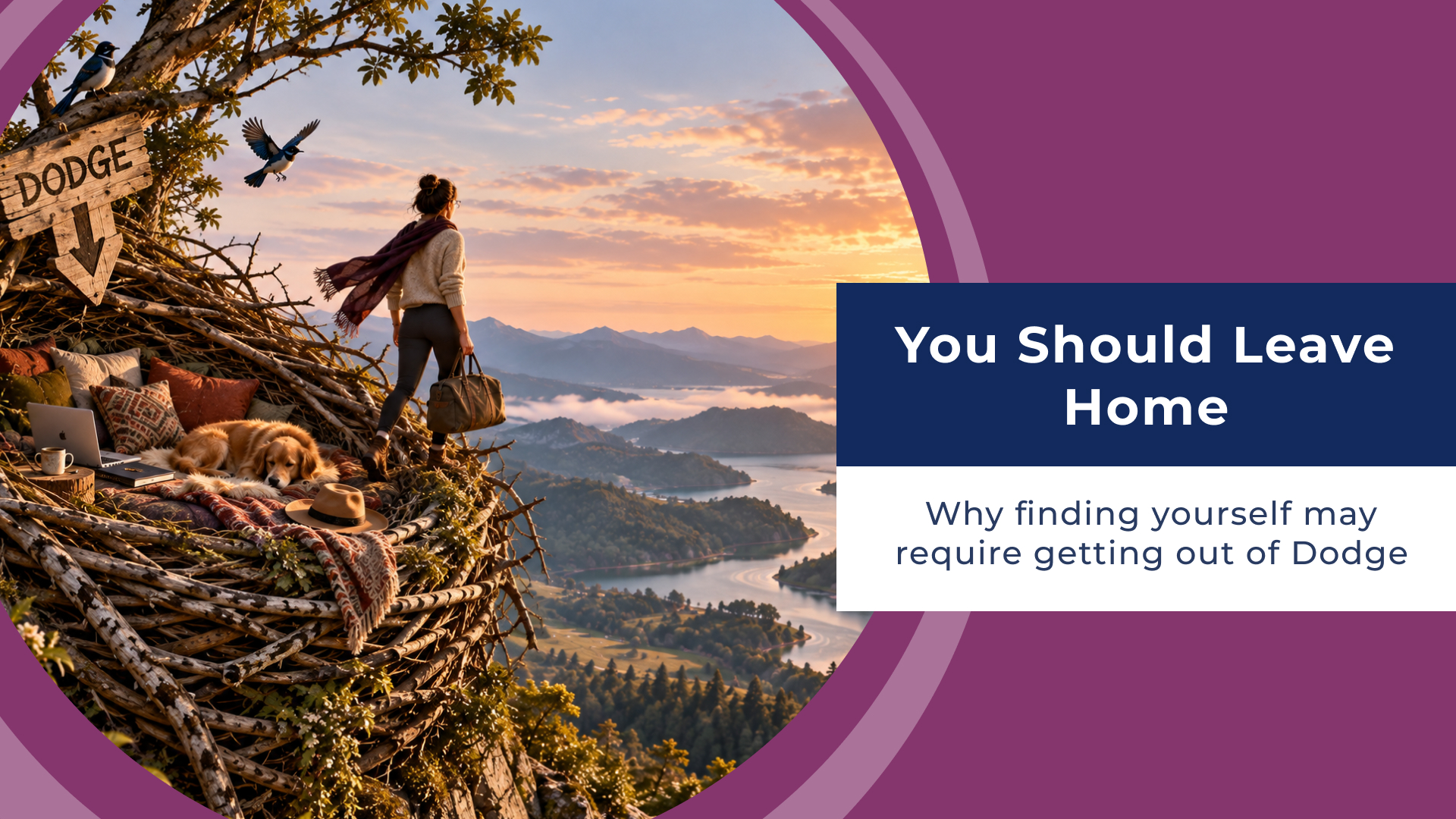
Women can become particularly accomplished nest builders. I mean that much more broadly than homemaking. We make relationships work, create routines, remember what needs doing, build careers and communities, develop competence and become part of the infrastructure that holds things together. There is an irony, then, in suggesting that sometimes the woman who has helped build the nest may need to climb out of it. Not because the nest is bad. Because it fits. Sometimes extraordinarily well. And there are things we cannot discover about ourselves while everything around us has been designed, deliberately or accidentally, around the person we already are.
Years ago, when my daughters were tiny, I travelled to Noosa for an executive leadership programme. At home I was the mother of two very young children, with all the relentless physical and mental choreography that entails. In Noosa I was suddenly surrounded by people thinking and talking about leadership, learning and possibility. Nobody needed their shoes found. Nobody needed feeding. For a brief period, motherhood was no longer the primary organising fact of my identity, and other parts of me had more room to speak. I came home feeling unusually expansive and, apparently, expressed this emerging sense of possibility through a small shopping spree. Transformation has many forms. I remember the feeling more than the purchases, although they were the grooviest outfits I’ve had in years.
I have written elsewhere that identity has a geography. We often imagine the self as something relatively fixed that we transport between locations, but who we are is also relational and contextual. Places make different things possible. So do people. So do expectations. Somewhere else, nobody knows that you are not usually adventurous, hate eating alone, are senior at work, terrible with directions, or the person everybody relies upon. You do not have to announce that you are becoming someone different. You simply get to try something without quite so much historical evidence arguing against you.
Sometimes you acquire new evidence. I have spent time at Gwinganna in Queensland, where on one visit I found myself participating in an experience that involved setting an intention to let go of past burdens and eventually burying a rock when I felt called to do so. At the beginning, I wasn’t entirely sure I knew what “setting an intention” meant. By the middle of the night, apparently my spiritual development had progressed sufficiently for my rock to demand burial at about three in the morning.
There were some practical difficulties. It was pitch black. I was in Australian rainforest country. I am petrified of snakes. Australia also contains a frankly unnecessary number of other creatures capable of making a woman reconsider her commitment to personal transformation. And the only implement I had available for this sacred nocturnal task was a spoon. So there I was, in the darkness, digging into the earth with cutlery. I could have contemplated courage at home. I could have read about trusting intuition or written thoughtfully about moving beyond fear. Instead, I was given an experience. Whatever meaning I made of it later had first been lived through my body: darkness, fear, absurdity, decision, action.
There is a considerable difference between telling myself I am resourceful and watching myself become resourceful when the plan falls apart. I can understand autonomy intellectually, discuss courage and repeat affirmations about trusting myself. Experience asks something different of me. It gives me an opportunity to behave, respond and choose, and then leaves me with evidence I did not have before. Perhaps transformation sometimes begins when an experience makes an old story about ourselves harder to sustain.
What becomes possible somewhere else?
This is not an argument that everybody should head into a rainforest with a spoon. Nor do I think another country contains a better or more authentic version of us. India cannot solve a marriage. Africa cannot give us self-worth. Italy cannot decide what career we should have. A retreat cannot promise transformation simply because the scenery is beautiful and the linen is expensive. Place matters. It matters because different places put us into different relationships with ourselves and the world around us.
Sometimes the encounter is difficult. Sometimes it is ridiculous. Sometimes it is almost unbearably beautiful, and sometimes a place carries qualities we experience as sacred or transformational. I have travelled through landscapes in Greenland that altered my sense of scale, walked among temples and ruins in Cambodia and had an elderly woman tie a simple thread around my wrist at Angkor Wat while holding my gaze in a way I can still remember. At Curio Bay in Aotearoa New Zealand, I went into the water and found myself swimming with dolphins. It wasn’t an excursion I had booked or an experience designed for transformation. I was simply there, they were there, and something about that encounter stayed with me strongly enough that it eventually found its way into poetry.
There is also reason to be cautious about making transformational travel too programmatic. Not everything meaningful should be scheduled. Sometimes place needs room to happen to us. A landscape can humble us, another culture can expose assumptions we did not know we carried, and a stranger can affect us without ever knowing our name. The learning is not simply about the destination. The destination participates in it.
For women, the act of going can carry another layer. Not very many generations ago, many women had considerably less freedom to travel simply because they were curious. Money, domestic responsibility, safety, social expectation and sometimes explicit permission shaped where women could go and why. For women whose family histories include migration, displacement or refugee journeys, leaving home may carry yet another meaning. Geography can represent possibility and freedom, but it can also carry memories of necessity, loss and survival.
It makes me reluctant to romanticise departure. Home can be beloved. Leaving can be frightening. Not everyone can travel and not everyone wants to. A plane ticket is not evidence of courage, and collecting countries is not the same thing as becoming more worldly. But there is still something significant about choosing, when we can, to put ourselves somewhere we are not already competent.
Getting out of Dodge
There are many ways to change a life. We can read, think, write, study, work with a therapist or coach, have a difficult conversation or simply decide to behave differently tomorrow morning. Transformation does not require a passport. But there are times when trying to see ourselves differently while remaining inside all the conditions that continually tell us who we are is remarkably difficult. Travel can change where we are standing long enough to change what we can see and, because it is embodied rather than merely intellectual, sometimes what we know. That does not mean every trip is transformational. We can fly halfway around the world and reproduce our ordinary lives almost perfectly, or travel surprisingly close to home and encounter enough unfamiliarity to notice ourselves differently.
The destination matters, but how we encounter it may matter more. Do we leave enough space for the place to interrupt us? Do we meet people whose lives are organised differently from ours? Can we tolerate not knowing? Do we allow ourselves to become temporarily incompetent? Do we experience a place, or merely consume it? And perhaps this is where the desire to “get away” deserves more curiosity than we sometimes give it.
Sometimes we simply need a holiday. Take it. Lie beside the pool. Read the terrible novel. Rest does not need to masquerade as transformation to be worthwhile. Sometimes the restlessness has another quality. Nothing may be dramatically wrong. The relationship may be fine. Work may be fine. The children may be fine. We may even have built much of the life we once hoped to have. Yet there can be a quiet sense that the coordinates have become too familiar, that we can no longer quite tell which parts of our lives are consciously chosen and which are simply beautifully practised.
At such moments, perhaps we do not need another book telling us who we could become. Perhaps we don’t need to think harder about the life we’re already standing inside. Perhaps, occasionally, we need to pick up a bag and put ourselves somewhere that doesn’t know the answers we usually give. Not because another country contains the real us. But because sometimes we need to get far enough from the life that knows us to discover what that life has made difficult to see.
So think about your own life for a moment. Where have you become so familiar to yourself that you may have stopped looking? And if something in you has been quietly whispering I need to get out of here, perhaps don’t dismiss it quite so quickly. You don’t have to know who you’re going to find. You may just need to leave home long enough to meet her.
Dr Jordan Marijana Alexander is an executive advisor, human systems strategist and writer exploring how identity, place, culture and living systems shape participation in the modern world. She works alongside leaders, boards and organisations navigating complex questions of leadership, change and participation, and is the co-founder of RelateAble.Global. If this article has raised questions, sparked reflection or highlighted a decision you’re carrying, you’re invited to book a confidential conversation. You can follow DrJMA on LinkedIn and Engenesis for ongoing essays, reflections and research exploring leadership, identity, belonging and participation.