
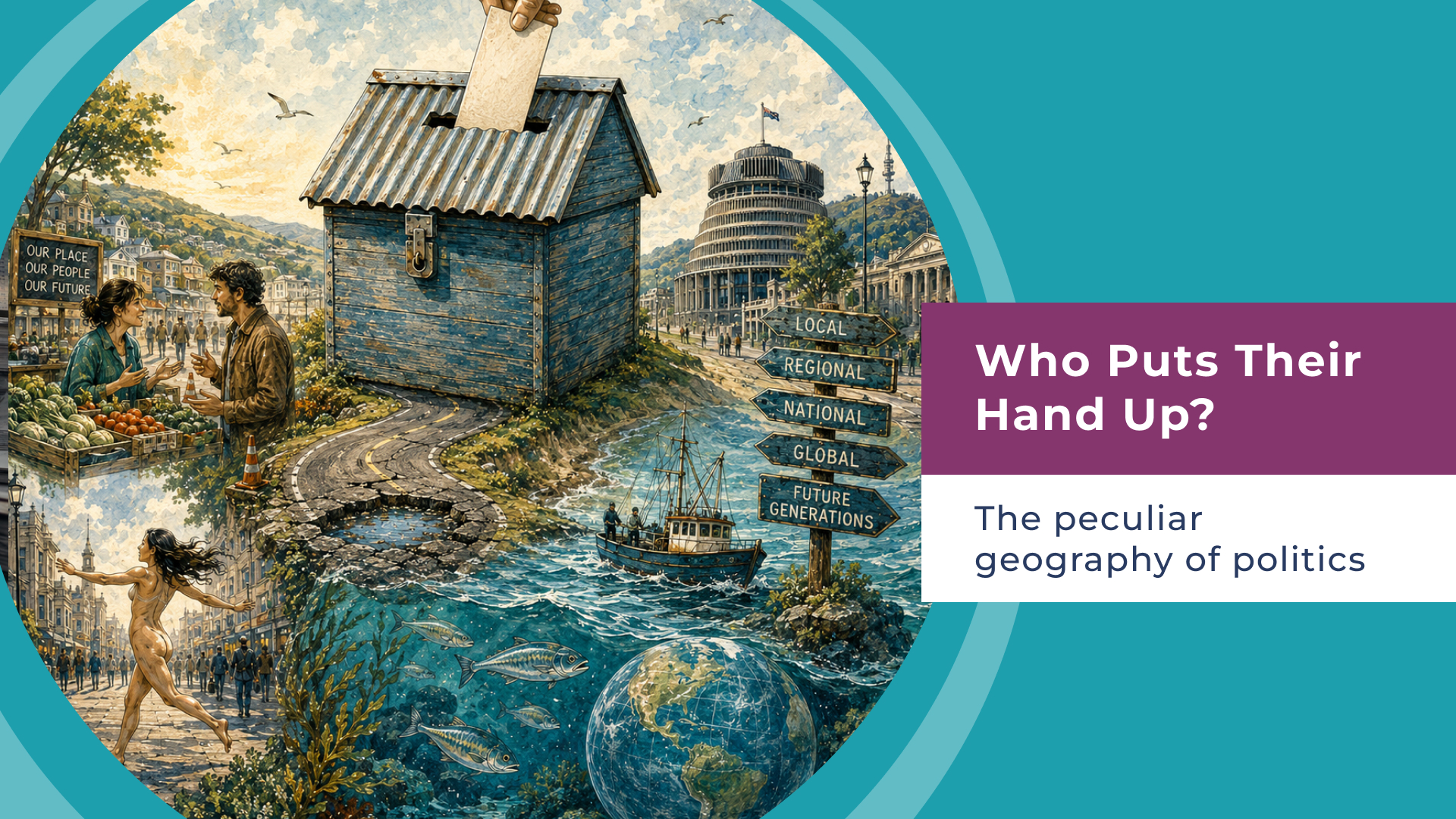

Here I am. Judge me.
There are many ways to participate in public life. Standing for election may be one of the stranger ones. At some point, an otherwise private citizen fills in a form, attaches their name to a collection of beliefs, promises and priorities, and effectively announces to several thousand strangers: Here I am. What do you think? Their face appears on hoardings. Their opinions become searchable. People they have never met begin forming conclusions about their competence, character, motives, hairstyle and quite possibly their choice of jacket. And they volunteered for this.
I have been thinking about voluntary exposure recently because I have started publishing poetry. Over coffee, a friend asked me why I would put something so personal into public view. It was a fair question, and one I am not entirely sure I can answer. Publishing poetry is not the same as running for public office, obviously, but it has given me a small and unexpectedly visceral appreciation of choosing to be seen, interpreted and judged by people I may never meet. Some days it feels remarkably like running naked through the streets. Nobody made me do it. Somehow that makes it worse.
Political candidates do something considerably more consequential. They put not only their words but themselves forward. They ask to represent other people, which requires those people first to judge whether they are someone they want representing them. There is ambition in that, undoubtedly, but also service, conviction, frustration, ego, hope, duty, anger, optimism and sometimes, I imagine, the fairly sincere belief that everybody currently doing the job has made such a mess of things that surely you could have a go. Human motives are rarely tidy enough to fit on an election pamphlet.
Yet before any ballot can be cast, somebody has to put their hand up. That interests me because we spend enormous amounts of time analysing how people vote and comparatively little wondering about the human beings who make themselves available to be voted for. What makes one person believe they have something worth contributing to public life while another, equally capable person, would never imagine that the council chamber, parliamentary bench or mayoral office could belong to someone like them? And then there is another question, one that becomes more interesting the longer I think about it. Where exactly are they putting their hand up from?
The supermarket test
Politics is always practised somewhere. Even our grandest ideological arguments eventually land in actual places inhabited by actual people. They become the road we drive on, the school our children attend, the water coming through the tap, the park at the end of the street, the bus that does or does not arrive, the rates bill on the kitchen bench and, inevitably, the pothole that has been attempting to destroy the front left tyre for six months.
At the local level, the relationship between representative and represented can be extraordinarily intimate. Your councillor may also be the person standing behind you at the supermarket. The person who wants to discuss the pothole may be selecting tomatoes beside you. Constituents can appear at the school gate, sports club, café or community meeting. There is something wonderfully inconvenient about this form of democracy: the geography keeps putting the people whose decisions affect one another back in the same room.
Proximity matters. It is harder to reduce somebody to an abstract category called ratepayer, business owner, young person or pensioner when you know their name, understand where they live and may encounter them again on Saturday morning. Place gives politics texture. It turns “the community” from an administrative noun into people with faces, histories and very specific opinions about rubbish collection. But proximity creates its own difficulties. The pothole is not an abstraction either. It is here. It is damaging my car now. I can point to it. I can photograph it. I can show you the invoice from the mechanic. And if you are my elected representative, I can find you beside the broccoli and ask what you intend to do about it.
Which raises a problem for politics that is not only about geography. It is about time. The things we most urgently experience are not always the things that most urgently require investment, and some of the wisest decisions produce remarkably little that anyone can see.
I have recently spent around NZ$50,000 reroofing my house, an investment so spectacularly invisible that I am considering commissioning a drone photograph and hanging it beside the family portraits. The Roof, 2026. Mixed media: steel, timber and financial grief. NZ$50,000. Nobody visits and admires it. There has been no ribbon-cutting ceremony. Friends do not stand in the garden murmuring appreciatively about the long-term integrity of the building envelope. Its principal contribution to my quality of life is that nothing happens. The rain remains outside. Infrastructure suffers from much the same public-relations problem.
Much of good government is similarly uneventful. The pipe does not burst. The bridge remains standing. The drinking water remains safe. The flood protection holds. The road continues functioning. The money required to produce those non-events, however, is spent very visibly today. This creates an uncomfortable tension for elected representatives. The people who elect them have immediate and legitimate needs, while many of the systems they are responsible for stewarding operate across decades. Repair the pothole or replace the ageing pipes? Reduce today’s rates or invest in infrastructure that people may not appreciate until long after everyone who made the decision has left office? Fund the visible improvement or the invisible prevention?
Electoral cycles sharpen the tension. In New Zealand, national governments face voters every three years. Infrastructure, environmental restoration, urban development and social change frequently work on timelines considerably longer than that. A politician may make an expensive and unpopular decision today whose benefits become visible several elections later, perhaps under a completely different government. There may not even be a ribbon to cut.
This does not mean politicians are incapable of long-term thinking or that voters are selfishly obsessed with potholes. The pothole matters. So does the pipe underneath it. The democratic challenge is holding both realities at once: being sufficiently close to understand what people are experiencing today while remaining sufficiently farsighted to protect what they may need tomorrow. An electorate, after all, exists for longer than an electoral term. So does a town. So does a river.
Representing here from there
Scale complicates things further. A local councillor represents a comparatively small geography. A mayor carries a larger one. Regional representatives hold multiple communities and competing interests within the same boundary. National politicians may represent a particular electorate while also participating in decisions affecting an entire country. Every step outward increases not only the size of the geography but the complexity of belonging to it.
There is a peculiar tension here. Sometimes representing a place requires leaving it. An electorate MP may need to spend substantial time in the capital precisely because that is where the institutions through which they can represent their electorate are located. They must be there to act effectively for people here. At the same time, the more time they spend there, the greater the risk that constituents experience them as somewhere else.
The tension is beautifully dramatised in the Australian political series Total Control, in which an Indigenous senator is pulled between Canberra and the community from which her political authority and relationships arise. It is not simply a question of divided loyalty. It is something closer to dual presence. How do I remain sufficiently of this place to represent it authentically while participating in a political system located somewhere else? And how do I advocate for the people who elected me while accepting responsibilities that extend beyond them?
National government requires that second move. A minister cannot simply ask what is best for their electorate. They may have to support a decision that serves a larger national interest while creating real difficulty at home. Regional representatives encounter versions of the same problem between communities within their region. Politics continually asks people to enlarge the circle of what they are responsible for without losing relationship with the smaller circle from which they came.
Capital cities add another layer because they are peculiar places in their own right. Ottawa feels different from Toronto. No one would mistake DC and NYC. Canberra is not Sydney. Wellington is not Auckland. Capitals develop ecosystems around government: public servants, politicians, journalists, diplomats, advisers, lobbyists, consultants, associations, policy specialists and entire professions whose working lives are unusually saturated with the machinery of the state.
I have worked in and around different capital cities and have always been struck by the atmosphere they create. Conversations that seem entirely ordinary there can sound strangely specialised elsewhere. Political events travel quickly through professional and social networks. Changes in government policy are not only national news; they can alter the local labour market, household confidence, hospitality spending and the mood of a city. Wellington’s experience of substantial public-sector reductions is a contemporary reminder that the place from which national government operates is also somebody’s local economy.
Political time feels different there too. Years ago, when I was working as Private Secretary to the Hon Maurice Williamson, I found myself standing outside a men’s bathroom waiting for him to emerge because I needed him to sign something. There was no sophisticated lobbying strategy involved. There was simply no time. His diary seemed to move in tiny blocks; even haircuts had to be scheduled. If I wanted the signature, apparently this was where geography and democracy had brought me.
It was funny, but I remember the larger impression. Political representation creates an almost impossible demand for human presence. Constituents want access. Officials need decisions. Colleagues need conversations. Stakeholders want meetings. Media want answers. Communities want representatives to turn up. Families presumably occasionally hope to see them too. Everyone has a legitimate claim on a finite human being.
Perhaps that is why distance in politics cannot be measured only in kilometres. You can be physically present in an electorate and unavailable to its people. You can be hundreds of kilometres away and deeply related to what is happening there. Geography matters, but relationship determines whether distance becomes disconnection.
The fish don’t vote
There is, however, an obvious problem with relying on voters to tell politicians what matters. The fish don’t vote. Neither do rivers, reefs, underground pipes, future homeowners or children who have not yet been born. Yet political decisions made today can profoundly affect all of them. Representative democracy therefore asks something rather extraordinary of the people we elect: respond to the legitimate needs of people who can remove you from office at the next election while also stewarding interests whose consequences may not become visible for years or generations.
The story of Cabo Pulmo in Mexico’s Gulf of California offers a striking example. By the 1990s, decades of fishing had severely depleted the reef and the fish populations on which the local community depended. Local families supported creating a protected marine area and giving up fishing within it. Think about what that asks of people whose livelihoods come from the sea. Ecological recovery may sound admirable in a policy document. Feeding your family next month is considerably less theoretical.
Then came the particularly brutal part. After several years, there was little evidence of dramatic recovery. The community had absorbed the immediate cost while the promised future remained largely invisible. They kept going. Over the following years the ecosystem recovered spectacularly; researchers later documented a huge increase in fish biomass within the reserve.
The story is tempting to turn into a neat parable about sacrificing today for a better tomorrow, but that would make the decision sound easier than it was. The fisher votes. Their partner votes. Their bills arrive this month. Their children need feeding now. The future fisher does not vote yet. The fish never will. That is not simply an environmental problem. It is a problem of representation across time. And time is only one of the boundaries the fish refuse to respect.
It gets harder still when the thing being governed refuses to remain conveniently inside the geographical boundary we have drawn around it. A pothole is relatively cooperative. It exists on a particular road within somebody’s jurisdiction. Rivers are less obliging. Fish migrate. Water flows. Smoke moves. Ecosystems cross municipal, regional and national borders without consulting the legislation that created them. The atmosphere has never shown much respect for national sovereignty.
Political boundaries are human constructions. Consequences are under no obligation to respect them. This produces one of the paradoxes of political geography: proximity may decrease at precisely the point interdependence increases. The pothole is intensely local and relatively easy to locate within a system of responsibility. A fishery may cross multiple jurisdictions. A river catchment can connect communities that rarely think of themselves as sharing a political problem. Climate extends the circle further still, linking the actions and consequences of people who may live on opposite sides of the planet and never meet.
The concentric circles of representation therefore keep expanding: street, neighbourhood, district, region, nation, neighbouring nations, shared oceans, planet. Eventually we create institutions such as the United Nations because some matters have become larger than the political geographies through which we usually govern ourselves. Yet every movement outward makes representation more abstract. It is difficult enough to feel genuinely represented by somebody sitting in your local council chamber. What does representation mean when the relevant table is half a world away?
Perhaps political life requires us to keep moving between scales rather than choosing one. The pothole matters. So does the ocean. The person in front of us matters. So does the person we will never meet. It is an extraordinary range of interests to ask one elected representative to hold. But representation is only one side of the relationship. The concentric circles run back towards us too.
Voting is perhaps the most visible expression of democratic participation, but putting a piece of paper into a ballot box is the end of a much larger process, not the whole of it. Someone had to decide to stand. People had to decide what mattered to them. Candidates had to listen, persuade and be challenged. Communities had to encounter competing possibilities. Institutions had to establish rules, protect integrity and ensure votes could be cast and counted. Citizens had to pay enough attention to make a choice.
There is a fascinating asymmetry in this. Candidates expose themselves publicly. Voters are protected privately. The person standing for office says, in effect, Here I am. Judge me. Then, after months of public scrutiny, the citizen steps behind a screen and makes an extraordinarily private decision.
The ballot box therefore represents something much larger than the paper inside it. It sits at the intersection of trust, information, institutions, participation and place. That intersection has become more complicated as political persuasion has moved online. Digital platforms allow messages originating almost anywhere to enter the most intimate spaces of our lives. The controversies surrounding Cambridge Analytica and the wider use of personal data and microtargeting around the Brexit referendum and the 2016 US presidential election made data-driven political persuasion visible to a much wider public. Political influence no longer needs to be geographically close to us to feel personally tailored. What happens to place-based democracy when persuasion becomes increasingly placeless?
Who gets to put their hand up?
There is one final geography worth considering: the invisible boundary around who imagines public office is available to them at all. Putting your hand up requires more than conviction. It requires time, resources, confidence, networks and a willingness to be publicly judged. For some people it also requires navigating caring responsibilities, cultural expectations, financial constraints, harassment, personal safety or simply the absence of people like them in the rooms they are considering entering.
This is one reason representation cannot be reduced to whether everyone technically has the same opportunity to stand. Before somebody can put their name on a ballot, they must first be able to imagine themselves belonging there. That question interests me particularly when I think about women and Indigenous people entering public life, although the boundary is certainly not limited to either. Who has grown up seeing people like themselves exercising authority? Who has been encouraged to speak? Who has learned that ambition is admirable rather than unbecoming? Who can absorb the financial and personal costs of campaigning? Who has enough support around them to make public service possible?
Who puts their hand up is therefore partly a matter of personal choice, but choices are made inside social worlds. The candidates who appear on our ballot papers are the end result of thousands of earlier signals about who belongs, who leads, whose voice carries weight and who should perhaps leave politics to somebody else. And that shapes what the rest of us get to choose from.
Somewhere between the pothole and the planet
Perhaps this is why I keep coming back to geography. Politics can sound like an abstract contest between ideologies, parties and personalities, particularly when viewed from a distance. Bring it closer and it becomes much more ordinary. It is people trying to decide how they will live together somewhere. That somewhere may be a street, town, region, nation or planet. The decisions may concern tomorrow morning or a generation from now. At every scale, we are negotiating competing needs, finite resources, different ideas of fairness and different understandings of what should be protected, changed, funded, repaired or left alone.
Someone has to put their hand up to represent those interests. Someone else has to put their hand up and say the pothole matters. Sometimes somebody has to argue for the pipe nobody can see. Sometimes a community has to leave the fish in the sea. Sometimes somebody has to speak for a future resident who has not yet arrived. And the rest of us have to participate too. That may mean voting, but democracy asks considerably more of us than putting a piece of paper into a box. It asks us to remain related to the places we inhabit and curious about the places beyond them. It asks us to tolerate decisions whose benefits may not arrive immediately, while refusing to dismiss the real difficulties people are experiencing today. It asks us to think locally without pretending the world stops at our boundary, and globally without forgetting that every grand policy eventually lands somewhere.
Perhaps that is the peculiar geography of politics. Representation stretches simultaneously across place and time. The closer we are, the more vividly we can see what matters now. The further outward we travel, the more clearly we may see what depends upon something beyond ourselves. Neither view is sufficient alone.
Somewhere between the pothole and the planet, between this morning and the next generation, somebody has to decide what matters. Some of us will put our hands up to represent others. Most of us will decide who gets to do so. But all of us participate in what becomes possible through what we notice, question, support, challenge, protect and ultimately choose. The fish still don’t get a vote. We do. So who puts their hand up?
Dr Jordan Marijana Alexander is a writer, executive advisor and human systems strategist exploring how identity, place, culture and living systems shape participation in the modern world. She works alongside leaders, boards and organisations navigating complex questions of leadership, change and participation, and is the co-founder of RelateAble.Global. If this article has raised questions, sparked reflection or highlighted a decision you’re carrying, you’re invited to book a confidential conversation. You can follow DrJMA on LinkedIn and Engenesis for ongoing essays, reflections and research exploring leadership, identity, belonging and participation.