

The question
Last night I asked a room full of women a question I thought would be one of the easiest of the evening: “What do you need?”
I wasn’t looking for profound answers. In truth, I wasn’t looking for any particular answer at all. I imagined someone might say they needed more sleep, a holiday, an uninterrupted cup of tea, time alone, a conversation with a friend or simply a slower week. It is, after all, one of the simplest questions we ask. We ask children what they need. We ask colleagues what they need to complete a project. We ask aging parents what they need to feel comfortable. It is such an ordinary question that I scarcely gave it a second thought.
Instead, the room fell silent.
It wasn’t an awkward silence or the silence of people protecting themselves. It was quieter than that. Around the room, faces softened. Eyes drifted upward as though searching shelves of memory that hadn’t been visited for years. A few women laughed gently before apologising for not knowing what to say. Others began answering, only to stop halfway through their own sentences, uncertain whether what they had named was actually a need or simply another responsibility waiting to be fulfilled. The silence wasn’t caused by unwillingness. It was the silence of people searching for an answer that somehow felt both deeply familiar and strangely inaccessible.
What struck me most wasn’t that nobody answered immediately. It was that nobody seemed surprised they couldn’t. Almost everyone recognised the experience. Nobody looked embarrassed. There was an unspoken understanding in the room that this was somehow normal, as though many of us had quietly accepted that knowing what we need is far harder than it ought to be.
That moment stayed with me. These were thoughtful, generous, capable women who navigate complex lives every single day. Women who lead organisations, care for families, support friends, mentor colleagues and notice the smallest shifts in the people around them. They spend their lives paying attention. It made the silence all the more curious. How could people so perceptive struggle with such a simple question?
The more I sat with that experience, the less interested I became in finding a solution. Instead, I found myself becoming fascinated by the phenomenon itself. Beneath that silence, I suspected there might be an explanation that had less to do with motivation or mindset and far more to do with the remarkable way human beings adapt. What if the inability to answer wasn’t evidence that something was wrong? What if it was evidence that something had quietly changed? This inquiry led me away from the familiar language of self-care and into exploring the science of how attention works.
The brain that learns
Every second of every day, our brains perform one of the most extraordinary acts in nature. At this very moment your nervous system is receiving an astonishing amount of information. The pressure of your feet against the floor. The feeling of your clothes against your skin. The rhythm of your breathing. The temperature of the room. The position of your jaw. The conversation somewhere behind you. The steady beating of your heart. If every one of those signals demanded equal attention, life would become impossible. We would be paralysed by awareness, unable to decide what mattered and what didn’t.
Instead, the brain performs an act of extraordinary elegance. It filters. Researchers increasingly understand the brain as constantly sorting, predicting and prioritising. It simply cannot bring every signal into conscious awareness, so it learns from experience. It quietly asks, thousands of times each day: Does this matter? Does this require attention? Signals that repeatedly prove important become easier to notice. Signals that rarely influence our behaviour gradually fade into the background. Not because they disappear, but because the brain has learned they do not need to interrupt us. It is one of the great miracles of being human. It is also, perhaps, one of our greatest vulnerabilities.
Think for a moment about the hum of a refrigerator. When it first starts, you notice it immediately. A few minutes later it seems to disappear. The sound has not changed. Your ears have not stopped receiving it. Your brain has decided the sound carries no consequence and removes it from conscious awareness. The same thing happens with the feeling of a watch on your wrist, the weight of your glasses on your nose or the distant traffic outside your window. The signals continue arriving exactly as they always have. What changes is not reception but attention.
The distinction fascinated me because it made me wonder whether the women in that room had not lost touch with themselves at all. Perhaps their needs had continued sending signals with remarkable faithfulness. Over years of attending to countless other priorities, their brains had simply become extraordinarily efficient at looking somewhere else. I also realised I wasn’t only focused on the women in that room. I was beginning to wonder whether I recognised something of myself as well.
Fluency
When I first arrive in Croatia, something curious happens. Although Croatian was one of the first languages I ever heard, I no longer speak it every day. My vocabulary arrives a little hesitantly. I reach for words that once came effortlessly and occasionally find myself translating silently before I speak. There are moments when I wonder whether I have forgotten more than I realised. Then, by the second or third day, conversations become easier. Words that felt hidden reappear. Sentences arrive without effort. Somewhere during the first week I stop translating altogether, and before long I catch myself dreaming in Croatian. The language was never truly gone. It had simply become dormant. Every visit reminds me that fluency isn’t simply something we possess. It is something we practise. The pathways remain, becoming easier to travel each time they are used again.
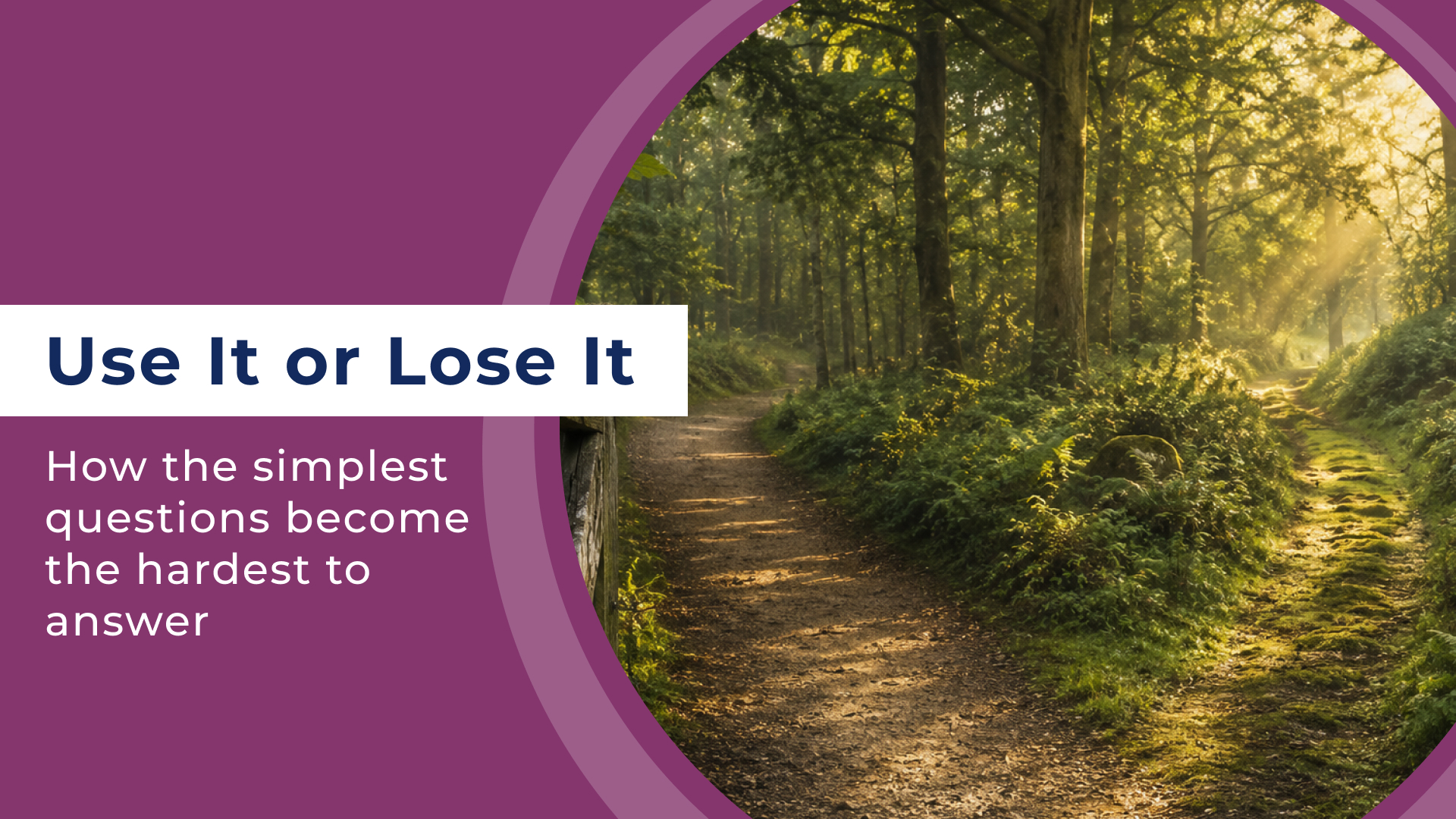
Neuroscientists have spent decades studying this remarkable quality of the brain. Connections that are used repeatedly become stronger and more efficient. The brain is not simply storing information. It is becoming fluent. Seen this way, the old expression “use it or lose it” isn’t entirely accurate. Most of the time we don’t lose the pathway at all. We simply stop walking it. Like a track through a forest, each journey keeps it open. Left untouched, grasses begin to grow, branches slowly fall across the trail and what was once obvious becomes increasingly difficult to find. The forest hasn’t changed. The traveller has.
Standing in that room, I couldn’t help wondering whether something similar had happened to our relationship with ourselves. Perhaps the question, “What do you need?” was never asking anyone to invent an answer they had never known. It was inviting them back onto a path they simply hadn’t walked for a very long time. Suddenly the silence looked different. The women hadn’t become disconnected from themselves. They had become exceptionally fluent at paying attention somewhere else. I began to wonder what happens to a signal that arrives faithfully every day, yet is almost never followed. The brain simply becomes better at listening elsewhere.
The unheard conversation
If fluency grows through repetition, what happens to a conversation that is quietly interrupted every day? Imagine the body saying something as simple as, I’m tired. Not exhausted. Not burnt out. Just the gentle nudge that perhaps today might be a good day to finish a little earlier, leave the dishes until morning or sit in the garden for ten minutes before moving on to the next task.
The signal arrives. You notice it. Then life asks something else of you. There are emails to answer, children to collect, dinner to prepare or a friend who needs your support. None of these things is unreasonable. Most are expressions of love, responsibility and contribution. So you set the signal aside and continue with your day.
Tomorrow the conversation begins again. I’m tired. Again, something else needs your attention first. The following day, it happens once more. There is no single moment when you consciously decide that your own needs no longer matter. No declaration that says, From this day forward I will ignore myself. There are simply hundreds, then thousands, of entirely ordinary moments in which another conversation takes precedence.
From the brain’s perspective, something remarkable happens. Every repetition becomes information. The brain is constantly learning from experience, asking what deserves to interrupt conscious awareness and what can safely remain in the background. If a particular signal arrives repeatedly but rarely changes our behaviour, the brain gradually learns that it need not command quite so much attention.
The body has not stopped speaking. The conversation has simply become one we are less practised at hearing. Perhaps fluency changes because another language is spoken more often. The conversation with ourselves never truly ends. We simply become less accustomed to listening to it. If that is true, another question naturally follows: If our own needs are not the only voices asking for our attention, which conversations are we becoming fluent in instead?
The louder signals
Our own needs are never the only signals asking for our attention. Life is full of competitors. Some arrive with urgency. A child crying in the next room. A phone vibrating in our pocket. An aging parent needing help. Others are less urgent but persistent: the desire to do good work, to be dependable, to keep our promises, to avoid disappointing the people we love. Layered over these are the countless invitations of modern life: notifications, advertising, expectations, opportunities and the steady stream of information competing for our attention from the moment we wake until we fall asleep. Many of these things are expressions of love, responsibility and contribution. The problem is not that they exist. The problem is that the brain is constantly learning from whichever signals most consistently require action.
Every time a baby cries and we respond, the pathway strengthens. Every time an email demands our attention before our own fatigue does, the pathway strengthens. Every time someone else’s disappointment matters more than our own quiet longing, the pathway strengthens. Gradually, almost imperceptibly, the brain becomes extraordinarily fluent at recognising the needs of others, because those are the signals that have most often shaped our behaviour.
Meanwhile, our own signals continue to arrive with remarkable faithfulness. Hunger. Fatigue. Joy. Loneliness. Curiosity. Grief. Play. Stillness. They do not disappear. They simply become quieter within our conscious awareness because, over time, they have proved less likely to influence what happens next. This is one of the hidden paradoxes of adulthood. The more capable we become, the more people depend upon us. The more people depend upon us, the more external signals require our attention. The more consistently those signals shape our behaviour, the more fluent we become in noticing them before we notice ourselves.
For many women, this process begins long before adulthood. Although the same pattern can be found in many lives, women reveal it with particular clarity because so many cultures have rewarded attentiveness to others as a feminine virtue. Across families, schools and cultures, girls are often rewarded for being considerate, helpful, accommodating and emotionally attentive. They learn to notice when someone feels left out, when tension enters a room, when a sibling is upset or when a parent needs support. These are beautiful human capacities. They are among the qualities that hold families, friendships and communities together. Yet every strength carries an opportunity cost.
When attention is practised outward for years, even decades, the brain becomes exquisitely skilled at reading the emotional landscape around us. Many women can sense another person’s discomfort before a single word has been spoken. They notice the subtle shift in tone, the hesitation in a sentence or the expression that flickers briefly across a face. They respond almost instinctively because those pathways have been strengthened through thousands upon thousands of repetitions. It is a remarkable capacity.
The tragedy is not that we become so good at noticing others. It is that, in becoming fluent in everyone else’s language, we can gradually lose fluency in our own. Seen through this lens, the silence that filled the room begins to look very different. The women were not disconnected. They were highly trained. Their brains had become extraordinarily sophisticated at attending to the signals that life had repeatedly taught them mattered most. No wonder the question, “What do you need?” felt unfamiliar. It was not asking them to discover something new. It was inviting them to return to a conversation that had been patiently waiting beneath the noise.
The specialists we become
The more I reflected on that evening, the more I began to wonder whether this was never really a story about women at all. Perhaps it is a story about what human beings become fluent in. Every life asks something different of us.
Teachers become remarkably sensitive to the subtle shifts in a classroom. Long before a child raises a hand, an experienced teacher has often noticed the wandering attention, the uncertainty or the quiet withdrawal that tells them something needs their care.
Doctors become fluent in symptoms. A glance at a patient’s posture, complexion or breathing can reveal patterns the rest of us would never notice. Years of practice have trained their attention to recognise what experience has taught them matters.
Parents hear sounds that others sleep through, while traffic outside disappears into the background. Police officers learn to scan for threats. Musicians hear harmonies hidden inside ordinary conversation. Architects notice buildings. Gardeners notice seasons. Chefs notice flavour.
The brain is always learning what deserves its attention, and with enough repetition those patterns become second nature. What once required conscious focus gradually becomes effortless. We stop thinking about what we notice because noticing has become part of who we are. This is one of the simple truths of being human. We become what we repeatedly attend to.
Every life becomes an apprenticeship in attention. We rarely notice it happening because fluency feels natural from the inside. Yet slowly, almost invisibly, our attention educates us. It teaches us what matters. It teaches us what to overlook. Over years, those lessons become the architecture of who we are.
Attention allows us to develop extraordinary capacities, yet every specialisation carries an unintended cost. Whenever one pathway becomes stronger, countless others receive less practice. Fluency is never free. Every yes, however worthwhile, is also a no to something else. It is why self-awareness can feel so elusive. Not because we have lost ourselves. We have simply become brilliantly practised at becoming someone else.
Remembering the language
For much of my life I thought of self-awareness as a personal quality. Some people seemed naturally reflective, while others appeared less so. We speak about becoming more self-aware as though it were a skill to acquire or a destination to reach. I wonder now whether that is the wrong metaphor. Self-awareness is not something we possess at all. Perhaps it is something we practise. Or, more accurately, it depends upon what we repeatedly practise attending to.
If the brain becomes fluent in whatever consistently receives our attention, then self-awareness may be less about introspection than about cultivation. Like language, music or friendship, it is not maintained by good intentions but by repeated engagement. Attention is the practice. Awareness is one of its consequences. The silence I witnessed was evidence of adaptation; pathways overgrown through lack of use. It was simply the sound of a language waiting to be remembered.
There is a great deal written about becoming more self-aware. Much less is written about how we quietly lose fluency in the language of ourselves. Perhaps the question is not whether we know ourselves, but rather what we have spent our lives becoming fluent in. Like the Croatian that returns each time I step off the plane, perhaps the language of our relationship with ourselves is never truly lost. It has simply been waiting for us to begin the conversation again.
Dr Jordan Marijana Alexander is a writer, executive advisor and human systems strategist exploring how identity, place, culture and living systems shape participation in the modern world. She is the co-founder of RelateAble.Global. If this article has prompted reflection about the future of your organisation or your own leadership, she welcomes thoughtful conversation. You’re invited to book a conversation to explore it further. You can follow DrJMA on LinkedIn and Engenesis for ongoing insights, research, and practical resources.