

About this series
Who Are You Accountable To? is a six-part series exploring faith not as religion or belief, but as orientation. It examines the often-unspoken systems that shape how meaning, power, and responsibility are organised at work. Moving beneath purpose statements, values frameworks, and performance culture, the series explores what replaces uncertainty when certainty is demanded, how leaders justify decisions when metrics fail, and who or what ultimately becomes the reference point for action. Across cultures, generations, and history, it asks a confronting question: when outcomes are unclear and no one is watching, what are we actually answering to, and how will those choices be remembered?
The eye test
I recently had to renew my driver’s licence. This should not have been psychologically significant. As a transport planner, I would like to state for the record that I understand the importance of road rules theoretically. Practically, however, my family maintains a long-standing position that I am not the preferred person to teach others how to drive. Despite spending years navigating highways in multiple countries, road rules remain my nemesis. Roundabouts still feel philosophically negotiable to me. Whether this reflects a control issue, a sovereignty issue or simply an inability to care deeply about lane discipline remains unclear. The problem, however, was not my driving. It was the eye test.
I wear one contact lens for distance only, which meant that when I stared into the vision-testing machine at the licensing office, my short-distance eye saw absolutely nothing. The woman behind the counter asked me again to read the first line. I could not. The entire left-hand column may as well have been written in invisible ink. I had to retest at the optometrist where they mentioned I would also need a peripheral vision test. I nearly passed out. Not because I thought I would necessarily fail, but because for the first time it occurred to me there may come a point where I no longer drive myself home.
The thought arrived with alarming force and told a few friends. Suddenly my mind filled with flashes of old age I had successfully avoided until now. Dependence. Staying home more often. Watching doctors who looked barely old enough to have finished watching The Wiggles perform highly specialised medical procedures. Being called “ma’am” so frequently it could no longer plausibly be accidental.
At some point, the future stops feeling infinite. Something quietly shifts when a parent dies or a diagnosis arrives, maybe it’s a marriage that changes shape. For some it’s children leaving home. For others, the reading glasses begin living permanently by the bed. Recovery may take longer than it used to. Ambition becomes harder to distinguish from exhaustion. The life that once felt permanently under construction starts revealing itself as an actual life already being lived.
Looking back, the pressure to perform, the seduction of certainty, the fragmentation required to belong, and the exhaustion of self-translation all begin to converge at this point in life. Not as theory, but as lived experience colliding with time. The question is no longer whether success is possible, but whether the way we are participating is sustainable across an entire human life.
Midlife introduces distance
For many people, the deepest questions do not arrive early in life. They appear later, often after competence is no longer in doubt and the external markers of success are largely in place. Careers have been built. Families established. Reputations formed. Something remains strangely unsettled. The questions themselves are often deceptively ordinary: Is this it? What am I actually building? Who am I answerable to now? What will remain when I eventually step out of this role? These are not motivational questions. They are existential ones.
Midlife is frequently framed as decline or crisis. I suspect something else is happening underneath the cultural panic about ageing. Midlife introduces distance. Time starts stretching both forward and backward simultaneously. Earlier decisions reveal consequences that can no longer easily be revised. Future outcomes become more visible in outline, even if the details remain unclear. The fantasy of endless correction slowly gives way to the reality of accumulation. Temporal awareness changes accountability.
Earlier in life, accountability often feels immediate and performative. Deadlines, outcomes and achievement dominate. Visibility matters more than meaning. Humans organise themselves around proving capability inside systems that reward speed, certainty and momentum. Over time, though, accountability stretches. People begin thinking across longer horizons to legacy, care, continuity, and meaning across time. The question slowly shifts from “What can I achieve?” to “What will remain true about how I lived?”
Performance can organise a decade, sometimes even two. Achievement provides orientation for quite a long time. Recognition can temporarily stand in for significance. Eventually, however, those substitutes begin losing their charge. Success is not empty. It is simply incomplete. Performance answers the question: Did I succeed? It does not answer: Was this worth succeeding at? So many high performers experience exhaustion not from effort but by misalignment. The years spent organising life around forms of participation no longer feel fully coherent internally.
Women speak quietly to one another about this stage of life. The strange disorientation of menopause. The sudden awareness of time. The way identity, desire, exhaustion and mortality all begin arriving in the same room together. The body no longer sits politely in the background absorbing endless overextension without comment. Eventually it starts demanding negotiation.
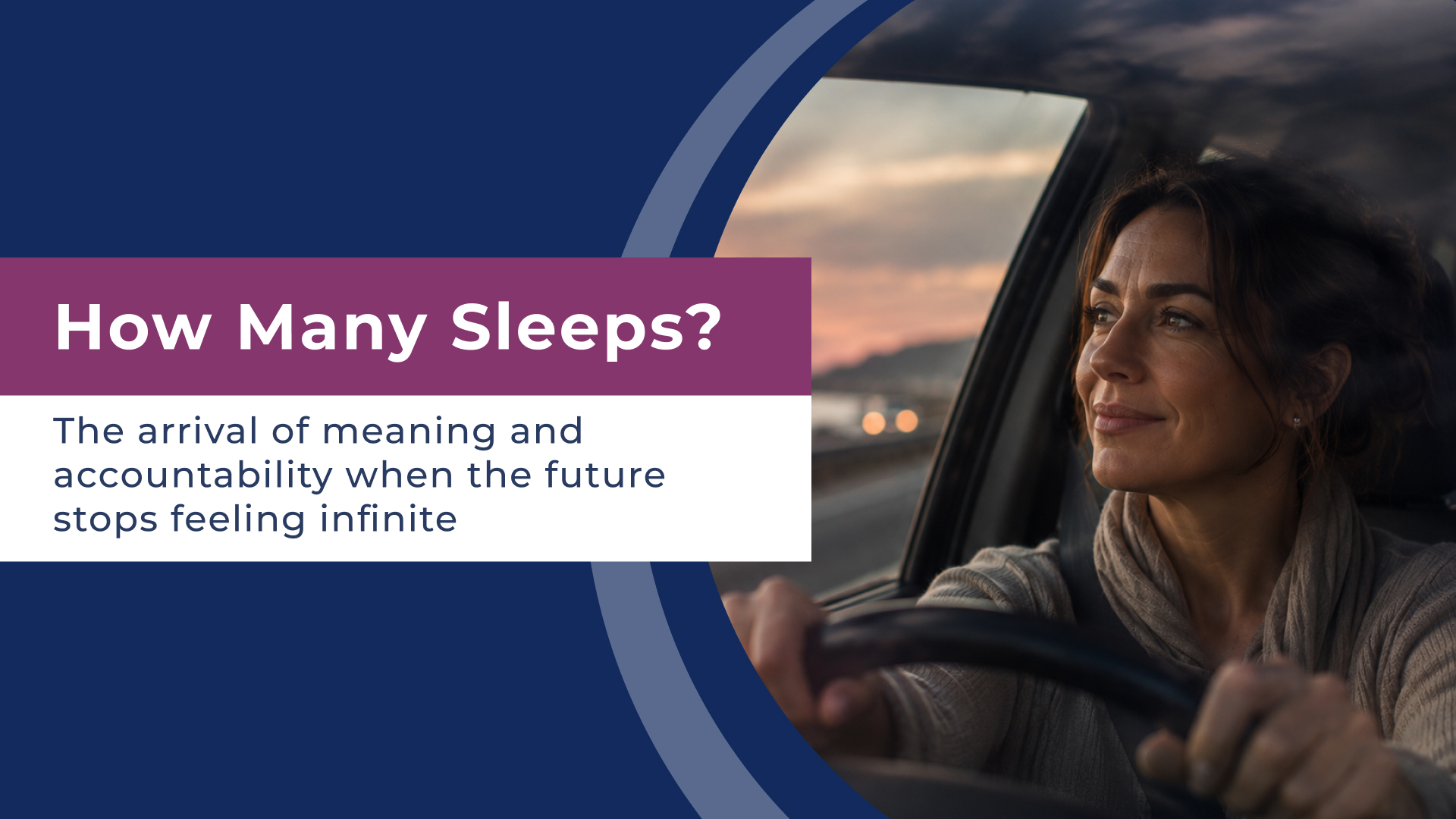
How many sleeps does one human get? And if you are entering the second half of life, how many remain? These questions create perspective, not catastrophe. Life is not infinitely deferrable, which is deeply inconvenient news for people who have spent decades assuming they would eventually get around to themselves later.
Organisations are not built for this moment
Modern societies are now trying to navigate these tensions at scale. Humans are living longer while remaining economically productive for more years than previous generations. Multi-generational workplaces place twenty-five-year-olds and seventy-year-olds inside the same systems while rapid technological and cultural change continuously reshapes the meaning of relevance, vitality and success.
At the same time, entire industries now exist to help humans resist visible ageing altogether. Anti-ageing medicine, optimisation culture, cosmetic procedures, longevity research and wellness economies all promise some version of extended vitality. Some of this reflects extraordinary medical progress. Some of it reflects a civilisation profoundly uncomfortable with limitation. Ageing confronts modern systems with a reality they struggle to process honestly: eventually the body refuses to remain merely an instrument of productivity.
Most organisations are not built for this moment. Systems driven by speed, extraction and certainty tend to struggle with slower human realities like grief, caregiving, illness, reflection and mortality. Quarterly targets continue while parents become unwell. Leadership responsibilities expand while marriages quietly collapse. Menopause arrives in the middle of board meetings. A diagnosis interrupts the fantasy that productivity and vitality are permanently guaranteed. And still the meetings continue.
This is partly why questions of wellbeing, care and social trust matter so deeply now across many societies. Countries like Finland consistently rank among the happiest in the world not because suffering disappears, but because trust, cohesion and institutional care are more strongly embedded across the lifespan. Research increasingly suggests that the clearest indicators of wellbeing are not individual, but relational. They are rooted in social trust and a sense of being institutionally held over time. The deeper question underneath modern wellbeing is no longer simply how humans perform, but whether they feel held while participating in society at all.
The things time makes visible
Time makes certain questions harder to avoid. What endures? What remains when productivity is no longer available as identity? What do I want to be accountable to when performance can no longer act as cover?
Underneath modern mobility and professional life, humans remain strangely ancient in the things that matter most to us. We still long for continuity, ritual and home. Care matters along with recognition. Someone remembering where we are. This is why people often become unexpectedly interested in ancestry, spirituality, gardening, pilgrimage, ritual, grief or mortality later in life. The shift is not irrational. It reflects the gradual weakening of structures that once organised meaning primarily through performance and progress.
Migration, family and place often occupy my mind. My father once told me he wanted to be buried in the family plot where he was born in Croatia. Instead, he rests in Canada. After his death, the discussion became unexpectedly complicated. Family members lived in different provinces by then. Questions of proximity, responsibility and migration entered the conversation alongside grief. Eventually someone asked the question sitting quietly underneath all the practical logistics: Who will bring flowers to his grave? I think about that often.
Faith as orientation
Faith becomes interesting again here, although not necessarily in the way many institutions frame it. It’s about orientation not morality. A way of locating ourselves inside something larger than achievement. Purpose asks where we are going. Meaning orients us to why this path matters. Over time, accountability becomes less about external validation and more about the quality of our participation while we are here. Attention shifts toward relationships, care, presence and whether our way of living leaves people more whole rather than more fractured.
Ageing changes the emotional atmosphere of life. Humans become less interested in appearing successful and more interested in feeling coherent. Less interested in performing identity and more interested in inhabiting it honestly. Less interested in winning every room and more interested in knowing which rooms still feel like home. From the outside, this can sometimes appear as slowing down. From the inside, it often feels like deepening.
Love as an accountability horizon
At some point, many people begin recognising that the future was never the only thing they were meant to be building. Ageing slowly reveals that underneath achievement, performance, adaptation and identity, humans spend much of their lives searching for ways to love and be loved without fragmentation. In the end, people are rarely remembered only for what they produced. They are remembered for how they loved, what they protected, what they nurtured and what they made more whole through their presence. Love turns out to be its own form of accountability. Not sentimental love, optics, or performance, but rather care and stewardship. The willingness to remain recognisably human inside systems that often reward fragmentation instead.
The time will come when performance slows, rooms empty, and the body changes. When the career ends, the children leave and when the night finally quiets enough for us to hear ourselves clearly again. The questions become surprisingly ordinary: Who did I love? Who loved me? What did I make more beautiful, more whole or more bearable through my presence? And when all the roles eventually fall away, was I still someone capable of recognising myself in the silence?
Dr Jordan Marijana Alexander works at the intersection of identity, leadership, and organisational systems. She is the co-founder of RelateAble.Global. If this series has surfaced questions for you as a leader, or raised challenges you are navigating within your organisation or your own life, she welcomes thoughtful conversation or inquiry. You can follow DrJMA on LinkedIn and Engenesis.