

An absolutely fabulous afternoon
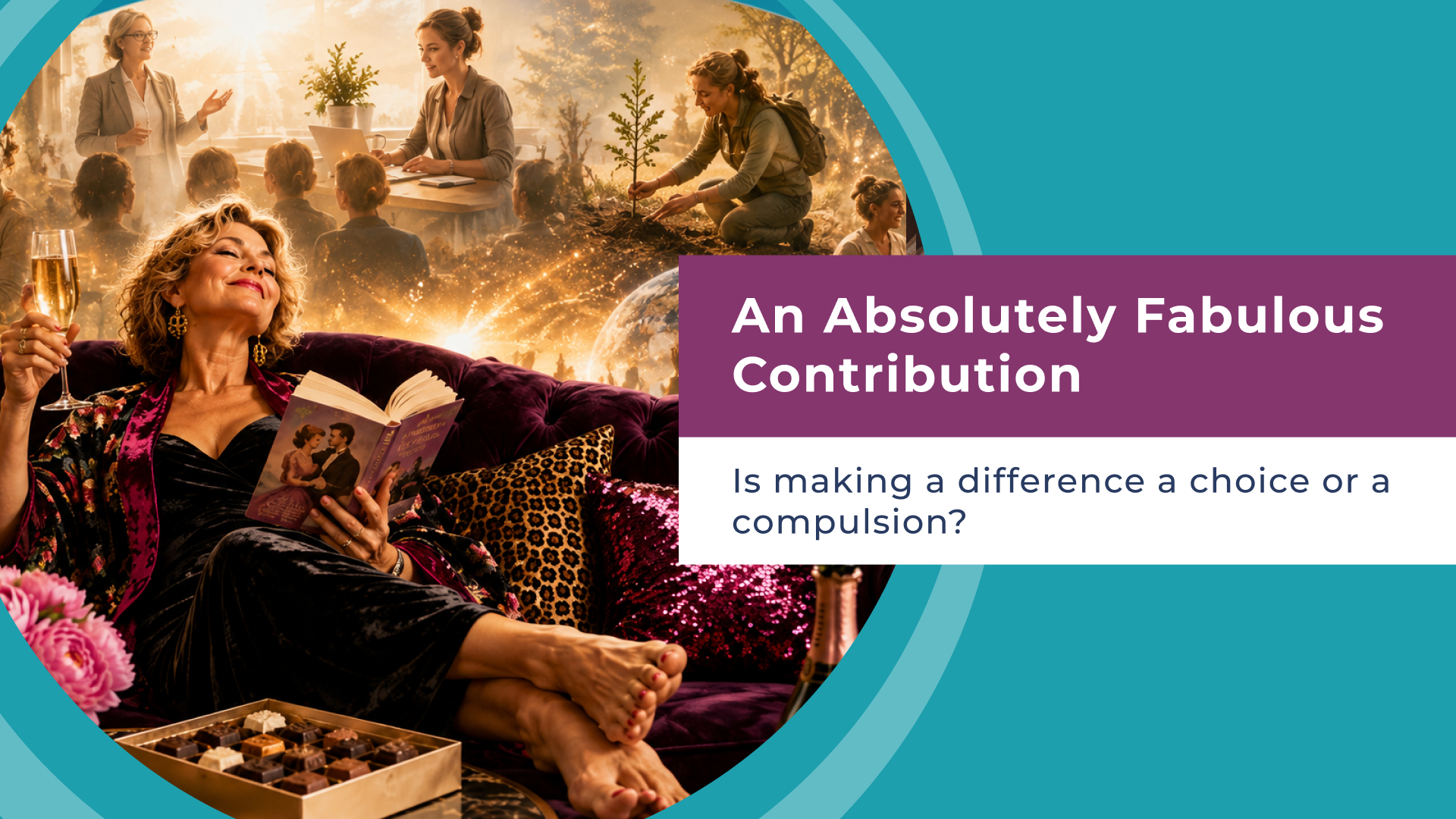
Imagine a woman in her late fifties stretched across a velvet sofa at two o’clock on a Tuesday afternoon. There is an indecently expensive box of chocolates open beside her, a glass of champagne within reach and a novel on her lap that nobody is ever going to describe as important literature. She has nowhere she needs to be for the rest of the day. In fact, if things go particularly well, she may not put on proper shoes.
She has no plans to start a foundation. She is not mentoring emerging leaders, training for a charity walk, volunteering at the local food bank or developing a social enterprise. She has not spent the morning identifying her purpose. There is no podcast being recorded about her next chapter. She is not leveraging forty years of experience to create positive social impact. She is having an absolutely fabulous afternoon.
What a waste. Or is it? There is something deliciously Absolutely Fabulous about the image. Edina and Patsy were hardly designed as models of mature female contribution. Champagne, fashion, excess, questionable decisions and an impressive commitment to pleasure were more their territory. They offer a useful counter-image to the increasingly familiar portrait of the purposeful woman in her second half of life: experienced, energised and ready to make a difference.
I meet versions of this purposeful woman all the time. Ask what she wants next and sooner or later some variation of the same phrase appears: I want to make a difference in the world. I understand it. I have said versions of it myself. It is a beautiful aspiration. There is much in the world worth caring about, and something deeply human in wanting our lives to be of value beyond ourselves. But lately I have become interested in a slightly more troublesome question. Did you choose it?
The trouble with a good life
Somewhere along the way, I think we have muddled together three quite different aspirations: a good life, a useful life and a consequential life. A good life might be loving, pleasurable, curious, connected and deeply ordinary. It may contain friendship, family, work, food, gardens, books, beauty, laughter, travel, solitude, belonging and afternoons on sofas. A useful life provides something others need. We care, serve, build, teach, earn, raise, repair, organise, volunteer, employ, feed, advise, create and help. A consequential life reaches toward impact. Something changes because we were here. An organisation grows, a profession shifts, a community changes, an idea travels, a movement begins, a body of work remains.
A life can contain all three. Very often it does. But they are not the same thing, and I wonder whether we have developed a peculiar tendency to treat the third as evidence that the first was worthwhile. This becomes particularly interesting in midlife. Ask a room of women what they want from the next chapter and “a good life” can sound strangely inadequate. Friends, travel, books, long lunches and enough money to enjoy them are lovely, obviously, but what will you do? How will you use everything you have learned? Who will benefit from your experience? What is your purpose now? What will you give back? What difference will you make?
We have spent decades trying to separate human worth from productivity, only to hand ourselves a more respectable performance measure in the second half of life: impact. We may no longer need the promotion, the title or the bigger office, but apparently we should still be doing something significant. Achievement changes out of the power suit, puts on linen, learns the language of purpose and comes back disguised as contribution. Crickey. Even leisure has KPIs now.
This is why the woman on the sofa makes such an interesting companion for this inquiry. If I tell you she spent the morning volunteering with former refugees before coming home to the champagne, everything becomes easier. She earned it. If the novel helps her recover from decades of service so that she can return refreshed tomorrow, we can approve that too. Rest is important, after all. Self-care enables contribution. But notice what we just did. We made her pleasure useful. What if it isn’t?
I want to make a difference in the world
“I want to make a difference in the world” may be one of the most socially approved aspirations of our time. It sounds generous without sounding pious, ambitious without sounding self-important. It fits comfortably into commencement speeches, leadership programmes, coaching conversations, social-enterprise pitches and retirement plans. Very few people are going to lean across the dinner table and say, “Really? Have you considered being less useful?”
The phrase contains several assumptions worth examining. Why the world? Why isn’t six people enough? Why isn’t one? Why isn’t raising a child lovingly a difference? Or being the colleague who makes a difficult workplace bearable? Why isn’t running an excellent small business, paying people fairly and doing what you promise contribution? Why does unpaid work sometimes acquire a moral glow that paid work mysteriously loses?
We seem to have created an informal hierarchy of contribution. Saving endangered species looks like contribution. Selling insurance requires more explanation. Volunteering at a hospice counts immediately. Running a profitable plumbing company may require us to point out the apprentices trained, families supported and homes kept functioning before it acquires equivalent moral standing. Caring for somebody else’s vulnerable child is service; caring for your own family is often simply life. Much of the contribution that keeps communities functioning is so ordinary that we stop seeing it.
Then there is “giving back”, another phrase I find increasingly fascinating. Giving back suggests a debt. Back to whom? For what? What exactly did we borrow? Sometimes the answer is obvious. We have benefited from communities, institutions, families, public infrastructure and the labour and generosity of people we have never met. Reciprocity is part of living together. Gratitude can quite naturally create a desire to serve. Yet “giving back” can also contain a quiet moral ledger: I have been fortunate, therefore I owe. I have accumulated experience, therefore I must use it. I have capacity, therefore I should make it available.
The same thing happens when we talk about “using our gifts”. It sounds unquestionably lovely until we ask whether a gift comes with an invoice. If I am a gifted pianist, do I owe the world music? If I have led organisations successfully, am I obliged to mentor emerging leaders? If I have money, how much must I give away before I am allowed to enjoy the rest? If I am good at caring for others, do I ever get to stop? When does capacity become conscription?
Contribution: choice or compulsion?
In Human Being, Ashkan Tashvir describes contribution as a Way of Being concerned with service and creating value for others because we care. Importantly, contribution is not confined to volunteering or grand acts of social good. It can occur through business, employment, public service, raising a family, art and countless other forms of participation. We are constantly benefiting from the contribution of others and, through our own participation in life, contributing in return. What particularly interests me, though, is the distinction the framework makes between a healthy and an unhealthy relationship with contribution. Healthy contribution involves willingness: seeking opportunities to serve and add value while remaining real about our own interests and needs. An unhealthy relationship can run in several directions, including disengagement and unwillingness to participate, but also something that receives far less attention: feeling compelled to support and serve others.
One word changes the inquiry. Two people can perform exactly the same act and have profoundly different relationships with it. One woman volunteers because she cares deeply about a cause and genuinely wants to be there. Another volunteers because saying no produces intolerable guilt. One executive mentors younger leaders because she loves seeing people develop. Another does it because being needed has become central to her identity. One parent cares for grandchildren every week because the relationship brings enormous joy. Another does precisely the same thing while quietly believing that a good mother or grandmother could never refuse.
From the outside, all four may look generous. Behaviour alone cannot tell us whether contribution is freely chosen. This is why I am increasingly suspicious of our enthusiasm for asking people, particularly in midlife, how they intend to contribute next. Many have been contributing for decades. They have raised children, supported partners, built careers, paid taxes, cared for parents, trained colleagues, served customers, kept households functioning, sat on committees, baked the bloody cupcakes, remembered birthdays, absorbed other people’s crises and somehow still turned up at work on Monday morning. Then, just as they finally acquire some discretionary time, we appear with a workbook. What is your purpose in the next chapter? Perhaps a perfectly reasonable answer is: I thought I might have a lie down.
The last respectable form of ambition
There is another possibility I find more uncomfortable still. Contribution can become the last respectable form of ambition. At twenty-eight it may be perfectly acceptable to say that you want to build something important, become successful, earn money, gain influence or be recognised for your work. Later in life, those ambitions can start to sound a little gauche. We know better now. We have matured. Our language changes. We want purpose. Impact. Legacy. We want to make a difference.
Often that shift is completely genuine. Experience can broaden our attention beyond ourselves. We become more aware of interdependence, more interested in stewardship and more conscious of what we might offer others. There is something beautiful about moving from acquisition toward contribution. But not always. Sometimes “I want to make a difference” may contain a quieter sentence: I need my life to have mattered. That is worth sitting with.
Do I want to serve, or do I need to be needed? Do I want to contribute, or am I frightened of becoming irrelevant? Do I want to leave something behind because I genuinely care about creating it, or because the prospect of leaving nothing behind terrifies me? Is this generosity, or has significance simply become my newest measure of success?
None of these questions invalidates the contribution that follows. Human motivation is rarely pure enough to survive that kind of test. We can care deeply and enjoy recognition. We can serve others and satisfy ourselves. We can create enormous public value while also enjoying money, status, influence or applause. The question is not whether our motives are spotless. It is whether we are free.
When time starts looking scarce
Perhaps this becomes more acute as we become conscious that time is not infinitely renewable. In youth, the future can feel almost offensively abundant. There will be another career, another city, another relationship, another project, another chance. Later, the arithmetic changes. There may still be decades ahead, but they no longer feel theoretical.
Scarcity can create urgency. Make it count. The thought is understandable and can be wonderfully clarifying. Stop postponing the book. Take the trip. Say the thing. Leave the job. Start the organisation. Use what you know. Do what matters. But “make it count” can also quietly become prove that it counted.
There are two very different ways of encountering the finitude of a life. One says, “There isn’t unlimited time; I need to make my mark.” The other says, “There isn’t unlimited time; how astonishing to be here.” One reaches instinctively toward significance. The other toward aliveness. Neither needs to be declared superior. There are lives that become gloriously consequential precisely because somebody finally realises time is short. But there are also lives diminished by the inability to experience an ordinary Tuesday without converting it into evidence of purpose.
This may be where abundance becomes something other than having endless time. Abundance might be the capacity to experience a life as already sufficient, and therefore to contribute from what we genuinely have to give rather than from a fear that we have not yet justified our existence. The outward behaviour could look identical. The inner relationship is not.
The courage to be ordinary
There is something deeply unfashionable about ordinariness in a culture fascinated by optimisation, transformation and impact. Even our second acts are expected to be remarkable. Reinvent yourself. Find your purpose. Build your legacy. Become the person you were always meant to be. There is another possibility: perhaps you already became a person, and perhaps that person is allowed to live.
The Adlerian ideas popularised in The Courage to Be Disliked, The Courage to Be Happy and recently, The Courage to Be Ordinary offer an interesting counterpoint to our preoccupation with exceptional significance. Part of their provocation lies in relinquishing the need to be extraordinary and locating meaning in participation in ordinary human life. Not every life needs to become a monument.
This brings me back to the distinction between a good life, a useful life and a consequential one. Perhaps one of the challenges of the second half of life is allowing them to separate again. I can live well without continually demonstrating usefulness. I can be useful without changing the world. I can have consequences I never planned and may never see. I can also choose periods in which I am none of those things except alive. That last possibility is harder than it sounds.
We are very good at rescuing pleasure by giving it a purpose. Gardening improves mental health. Reading maintains cognitive function. Friendship supports longevity. Travel broadens perspective. Rest prevents burnout. Hobbies foster creativity. Apparently even staring out the window requires an evidence base. What if I garden because I like dahlias? What if I read because the book is deliciously terrible? What if I have lunch with my friend because three hours disappear when we are together? What if I rest because I am tired? What if none of it is building toward anything?
The harder question in midlife is whether we can allow ourselves to retreat from usefulness without first earning permission to do so. Not because we have burned out, served enough, raised everyone, completed the important work or finally become worthy of rest. Simply because this is our life too. We may choose to step forward again. We probably will. But surely there must be some part of a life that does not have to justify itself before we are allowed to enjoy it.
The bonbon test
We have now reached the woman on the velvet sofa again. I could make the argument comfortable by expanding our definition of contribution until she qualifies. Perhaps her pleasure makes her warmer toward other people. Perhaps she contributes joy. Perhaps buying expensive champagne supports employment. Perhaps reading romance fiction sustains the arts. Give me long enough and I can probably build a respectable theory of social impact around the chocolates. But that would be cheating.
Let us assume her afternoon contributes absolutely nothing. Nobody benefits. Nothing is learned. No relationship is strengthened. No community is improved. She does not emerge refreshed and ready to serve humanity tomorrow. She drinks the champagne because she likes champagne, eats the chocolates because they are excellent and reads the novel because she wants to know whether the absurdly handsome duke finally realises he has been in love with the governess since Chapter Three. That is it.
Is she allowed? More importantly, if she did that for longer than an afternoon, when would we begin to become uncomfortable? A week? Six months? Retirement? At what point would we start wondering whether she ought to be doing something with herself? And if our answer is that of course she is allowed, but surely she would eventually want to do something meaningful, notice how quickly the moral requirement has slipped back into the room.
This is the test I keep returning to. A choice is only meaningful if not choosing it is genuinely available. If I tell myself that I freely choose contribution, but experience the alternative as selfish, lazy, wasted, irrelevant or morally inferior, then how free was the choice? Perhaps the courage to contribute begins somewhere unexpected: with the freedom not to.
This does not require us to abandon service, purpose or the desire to make a difference. Quite the opposite. Once contribution is no longer the price of a worthwhile life, what we choose to give may become more honest. We can volunteer because we want to. Mentor because we care. Build because something deserves building. Create because something wants expression. Serve because another person’s wellbeing genuinely matters to us. We can make an extraordinary difference in the world without requiring that difference to certify the value of the person making it. And perhaps we can stop asking every human life to become a business case for its own existence.
Our worth need not be conditional upon our usefulness. An ordinary life does not require justification through impact. We do not owe the world a monument simply because we were fortunate enough to live in it. So by all means, make a difference. Serve. Build. Teach. Mentor. Volunteer. Create. Care. Lead. Change some tiny corner of the world or, if you are so inclined, take a decent swing at the whole thing.
First make sure the sofa is genuinely available. Only then can you know that you chose to get up from it.
Dr Jordan Marijana Alexander is a writer, executive advisor and human systems strategist exploring how identity, place, culture and living systems shape participation in the modern world. She works alongside leaders, boards and organisations navigating complex questions of leadership, change and participation, and is the co-founder of RelateAble.Global. If this article has raised questions, sparked reflection or highlighted a decision you’re carrying, you’re invited to book a confidential conversation. You can follow DrJMA on LinkedIn and Engenesis for ongoing essays, reflections and research exploring leadership, identity, belonging and participation.